
In Kent, which is a notorious hard water area due to its chalk and limestone aquifers, your central heating system is under more stress than in other parts of the UK.
While the general national advice for a powerflush is every 5 to 6 years, the specific conditions in Kent mean you should look at the following timelines:
Recommended Frequency
- Hard Water Standard: For most homes in Kent, a preventative powerflush every 5 years is recommended to clear out the accelerated limescale and “sludge” (magnetite) buildup.
- Older Systems: If your system is over 15 years old and hasn’t been maintained, you may need a flush more frequently or a “deep clean” to prevent the heat exchanger from scaling up.
- New Boiler Installation: This is a great time for a powerflush. Most manufacturers (like Worcester Bosch or Vaillant) will void your warranty if a new boiler is fitted to an old, unflushed system in a hard water area, you can just flush or Magnacleanse the system at this stage but a powerflush is the best way to get your system working correctly with the new boiler.
Why Kent is Different
Kent’s water regularly exceeds 300mg/l of calcium carbonate. This leads to two specific problems:
- Limescale: Unlike “sludge” which is rusty metal, limescale is a rock-like mineral deposit. It acts as an insulator on your boiler’s heat exchanger, meaning your boiler has to burn more gas to get the same amount of heat into the water.
- Efficiency Loss: Research suggests that just 1mm of limescale on a heating element can reduce its efficiency by up to 7-10%.
Signs You Need a Flush “Now”
If you notice these symptoms, don’t wait for the 5-year mark:
- Cold Spots: Radiators are cold at the bottom but hot at the top (sludge buildup).
- “Kettling”: Your boiler makes a whistling or banging noise like a stovetop kettle (limescale on the heat exchanger).
- Cloudy Water: If you bleed your radiators and the water is black, thick, or contains “sandy” particles.
- Slow Warm-up: The house takes significantly longer to get to temperature than it used to.
How to Reduce Frequency
You can stretch the time between flushes to 8-10 years if you take these preventative steps:
- Magnetic Filter: Ensure a filter (like a MagnaClean) is installed on your return pipe. It catches the metal sludge before it reaches the boiler.
- Inhibitor Levels: Have your engineer check the chemical inhibitor levels during your annual service. They can top this up to prevent internal corrosion.
- Scale Reducers: In Kent, many engineers recommend fitting an inline scale reducer or a water softener to treat the water before it enters your heating loop.
Why we use a powerflush machine and Magnacleanse together
Using a Powerflush machine and a MagnaCleanse together is essentially the “gold standard” of central heating cleaning. While a standard powerflush is good, adding a magnetic filtration kit (like the MagnaCleanse) transforms the process from a simple rinse into a high-efficiency scrub.
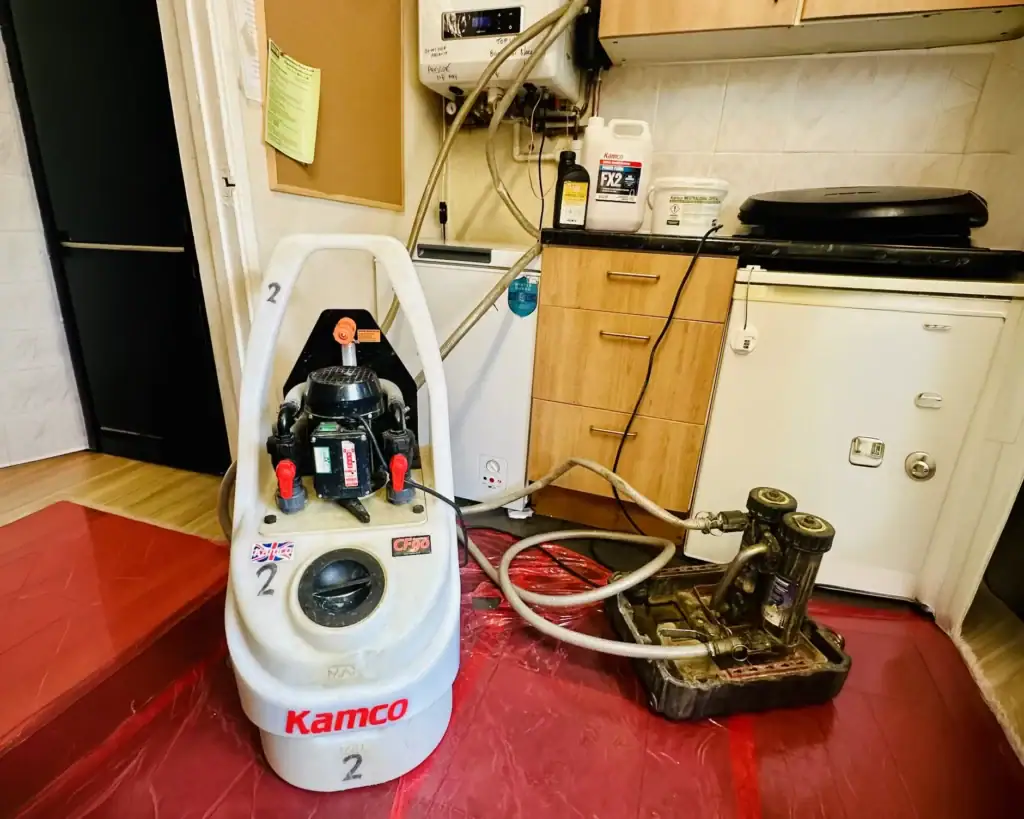
Here is why the combination is so much more effective, especially in a hard-water, high-sludge area like Kent:
1. The “Agitation vs. Capture” Dynamic
- The Powerflush Machine (The Agitator): This machine uses high-velocity water (and chemicals) to loosen debris. It’s great at dislodging heavy sludge and limescale from the bottom of radiators and the heat exchanger.
- The MagnaCleanse (The Collector): This is a large, transparent canister containing incredibly powerful magnets. As the powerflush machine pushes dirty water around the circuit, the MagnaCleanse instantly captures the iron oxide (sludge) as it passes through.
2. It Prevents “Re-Circulation”
Without a MagnaCleanse, a powerflush machine relies on the technician draining the dirty water out and replacing it with clean water.
- The Problem: Some of the loosened sludge often stays in the pipes, settling back down before it can be drained.
- The Solution: With the MagnaCleanse in the loop, the water is cleaned continuously while the machine is running. The sludge is pulled out of the water in real-time, meaning the water being pumped back into your radiators is already filtered and clear.
3. It’s Faster and Uses Less Water
Because the magnets are so efficient at grabbing “black iron oxide,” the water clears up much faster.
- A standalone powerflush can take a full day and waste a significant amount of water as the system is repeatedly dumped and refilled.
- The combo allows the engineer to “vibrate” the radiators (using a tool on the outside of the rad) to loosen sludge, which the magnets then catch immediately. You can actually see the sludge piling up on the magnets, giving you visual proof that the system is getting clean.
4. Better Protection for the Heat Exchanger
The heat exchanger in a modern boiler has very narrow waterways. If you use a powerflush machine alone, you risk pushing a “slug” of loosened debris directly into the heat exchanger, which can cause a secondary blockage. The MagnaCleanse acts as a guard, ensuring that any debris loosened from the radiators is caught before it can reach the delicate parts of the boiler.
You can also watch this easy-to-follow video for more info and a visual guide to what’s involved.
To book a powerflush for your central heating system or to find out more from the team, call 01227 263473